
Logan County Civil Docket Searches
The county clerk points searchers to Logan County Records Search. County materials describe it in terms of case numbers and defendant names. The site needs JavaScript to run. There is no indication it offers civil-only filters, partial-name lookup, party roles, or date filters. Document images, payment details, and coverage across all divisions are likewise not indicated. So treat a hit as a lead, not a complete civil file.
For a Common Pleas civil matter, the real case number or court paper beats guesswork. If your case fails to appear, call the clerk. Ask whether it sits outside online coverage, is restricted, is archived, or belongs to another division. Contact that court first for city court papers. Do not assume the Logan County system includes them.
- Identify the court and exact case number from the complaint, notice, judgment, or other court paper.
- Use Records Search for a likely Common Pleas matter with the verified case-number or defendant-name concept.
- Match the displayed court and case number to the underlying paper before reading entries.
- Ask the relevant clerk about public documents, inspection, copying, certification, or a missing result.
Logan County Civil Caption Clues
Local Rule 2 offers a handy caption convention for Common Pleas. The code CV marks "all other" actions. These are matters outside the rule's listed criminal, domestic-relations, and URESA designations. Seeing it helps you recognize a civil caption on a Logan County court paper or a clerk communication. That is all it does. It creates no case number. It promises no particular search form and does not guarantee that a CV case is visible online.
The Logan County Court Rules spell out the caption system. Rely on the printed case number, never on one you build from the abbreviation. The court name still matters. Civil records may live in Common Pleas, Bellefontaine Municipal Court, or another court with its own access channel.
- Caption
- The case heading that identifies the court, parties, and case type.
- Counterclaim
- A claim raised against another party within an existing civil action.
- Garnishment
- A post-judgment procedure with its own filing category on the clerk's schedule.
- Judgment debtor examination
- A clerk-schedule category connected with post-judgment proceedings, not proof of a current balance.
Civil Dockets: What They Show
Think of a civil docket as the court's chronological register of a case. It can show party names, filed pleadings, motions, orders, and settings, plus a judgment or dismissal entry where those details are public. But it has limits. The register alone does not prove a current payoff amount, an enforceable lien, the status of a separate title record, or the contents of every filed document.
| Case number | The court's assigned identifier. CV may appear in a Common Pleas caption as a local civil clue. |
|---|---|
| Parties | The named litigants, which should be checked against the court and case number before relying on a result. |
| Filed items | Entries for pleadings, motions, orders, or other case events, subject to public-access limits. |
| Setting | A scheduled court event. It can move, so verify a date directly with the court. |
| Judgment entry | A recorded decision or dismissal when public; a docket entry is not a current collection statement. |
A missing image or attachment proves nothing about whether a record existed. Ask the clerk instead. The clerk can tell you whether public inspection, a redacted document, an uncertified copy, or certification is available for a particular Logan County civil case.
Logan County Civil Filing Fee Lines
The clerk's published filing-fee schedule, effective November 1, 2025, lists several civil filing categories. Those figures cover starting or processing a filing. They are not the cost of viewing an existing docket. Copies, certification, mailing, and electronic transmission cost extra. Ask the clerk about record-access charges before sending any payment.
| Listed civil filing item | Published filing fee |
|---|---|
| Original civil complaint or petition | $400 |
| Counterclaim, crossclaim, or third-party complaint | $400 |
| Order of sale | $500 |
| Foreign judgment, garnishment, or judgment debtor examination | $175 |
The fee lines show that the clerk keeps distinct civil and post-judgment categories. They say nothing about whether a remedy exists, whether service is included, or what your case actually requires.
What Cases Fill the Civil Docket
Where does a Logan County civil case land? That depends on jurisdiction, amount, subject matter, and other facts. Common Pleas and municipal court both take civil filings. Ohio court-structure material says municipal courts generally handle civil matters not exceeding $15,000. Statutes and exceptions apply. That is general structure, not a routing decision for any specific dispute.
- Original civil complaints or petitions handled through the clerk's Common Pleas filing process.
- Counterclaims, crossclaims, and third-party complaints listed in the clerk's civil filing schedule.
- Post-judgment categories such as garnishment or a judgment debtor examination.
- Foreign-judgment filings, which have their own clerk-schedule line.
- Municipal civil or small-claims matters, when the named court has jurisdiction and maintains the case.
A civil docket is not a deed index. Nor does it guarantee current collectability. For a title, recording, or deed issue, do not assume the Clerk of Courts holds the record just because a civil case exists.
Logan County Municipal Civil Checks
Bellefontaine Municipal Court is the municipal-court route named for the county under R.C. 1901.02. The city's pages share traffic and criminal contact information plus a city-linked record and payment route. They describe no detailed civil or small-claims search workflow. A traffic screen proves nothing about municipal civil cases.
Call Bellefontaine Municipal Court with your questions. Ask whether the case number is municipal. Then ask whether the matter is civil or small claims and whether the online interface covers that category. Ask separately about docket access, public documents, inspection, copies, and certification. The city's current civil records coverage is simply not documented beyond this.
Hearings on the Civil Docket
A Logan County civil docket line may list a hearing or another setting. That line is a plan, not a lock. The General Division posts current scheduling in a PDF on its Current Court Calendar page. It works well for a posted date right now. It does not give the whole docket history. It also skips every division and any final result in the case.
Check the calendar page on the day you need the setting. Write down the calendar date shown and the time you opened it. Then confirm attendance details with the court itself. A continuance, cancellation, courtroom change, or remote-access instruction can arrive after a PDF is saved. The Logan County Court Schedule walks through the county process for finding and verifying settings.
Note: a current case setting is not proof of any later ruling. It is not proof of a dismissal or collection status either.
Logan County Civil Record Requests
For civil record and filing questions, the Logan County Clerk of Courts Legal Department sits at 101 S. Main St., Room 218, Bellefontaine, Ohio 43311. It answers at 937-599-7275. The Common Pleas General Division is upstairs in Room 205 and lists 937-599-7260. Which office you call depends on the question. Ask the clerk about an existing case file. Go to the court office for scheduling, assignment, or a court-specific access issue.
Focused civil request
Provide the court, case number, record type, and approximate date. Ask whether the public docket is inspectable and what the current copy or certification process costs.
Historical civil request
State the record class and date span. The county's guide routes older civil material differently from current clerk-held records.
The county public-records policy covers county-agency records. Court records are different. They answer mainly to the Rules of Superintendence and any court order in force. That policy sets no court-certified-copy rate.
A focused request works best. Ask whether the clerk keeps a public docket and copies for a named Logan County Common Pleas case. Then ask what inspection, copy, and certification steps apply. If access is limited, request the rule, order, or office that can resolve it. That framing keeps your inquiry on record custody. It also avoids asking staff for a legal conclusion.
Who Can See Civil Dockets
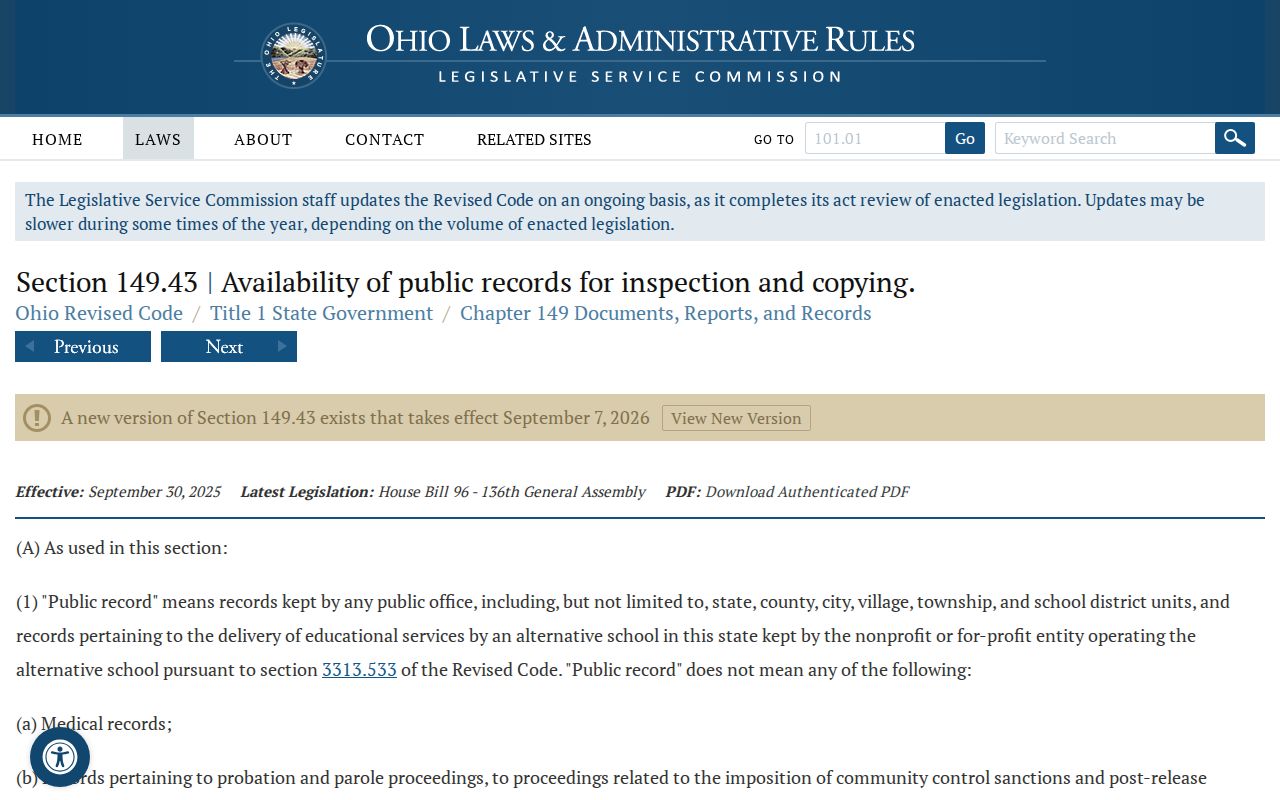
Ohio court access starts with Sup.R. 44 and Sup.R. 45. Those rules define court records and case documents. They set out public access, require personal identifiers to be omitted, and permit restrictions in defined situations. Ohio's R.C. 149.43 matters too, especially for county agencies. It does not erase the court-specific access framework, though.
Ask the proper Logan County custodian about the docket or the exact document you want. A hit in a public index does not mean an attached document is viewable. A miss does not mean no case exists. Redaction, sealing, an access order, spotty online coverage, a different division, or archived storage can all shape the answer.
Key Rules:
Sup.R. 44 defines Ohio court-record terms, including court records and case documents.
Sup.R. 45 sets public-access and personal-identifier protections for court records.
R.C. 149.43 addresses access to Ohio public records subject to applicable exceptions.
Ohio's public-records statute governs open-records duties across the state, and it is the authority behind the Logan County civil docket access material that follows here.
Send any request to the right court or clerk. If a document cannot be provided as asked, request the redacted public version or the record-access step that applies instead.
Logan County Historical Civil Records
Digging into older files changes the routing. Logan County's genealogy and historical-record guide places civil records from 1818 through the late 1940s with the Logan County Genealogical Society. Records from 1941 to present sit with the Clerk of Courts. The transition years overlap in that wording. So pin down the exact record type and year before you chase a file.
Contact the named custodian before assuming a year is digitized or open to inspection. Give the civil category, an approximate date, and any case number you know. Keep in mind that historical routing does not promise every item is open, complete, or kept in a modern electronic docket. A call before a visit pays off. The right Logan County custodian can hinge on the record category and date range rather than the subject alone.